


Three Frenchmen—Jean-Paul Kauffmann, Michel Seurat, and Marcel Carton—were kidnapped in Lebanon by Iran-backed militias in May 1985. Kidnapping and hostage-taking were methods these militias frequently employed at the time. This case, however, had a major impact in France, prompting efforts to secure the hostages’ release. The BBC’s 2009 documentary Iran and The West, produced for the thirtieth anniversary of the Islamic Revolution, recounted the episode through firsthand testimony. Then-French Foreign Minister Roland Dumas pursued back-channel diplomacy with Iran, saying: “We are not stupid. Iran supports them [Hezbollah] because we support Iraq. So we need to reach an agreement with Iran [rather than Hezbollah].” Then-President François Mitterrand said: “I thought we could not gamble with French lives.” Through an intermediary, contact was established with Mohsen Rafighdoost, then minister of the Revolutionary Guards—a ministry abolished in 1989—and the hostages’ release was requested. As Rafighdoost himself recounts in the documentary, he answered: “But what can I do?” and said, “We have no influence over them.” His French counterpart replied: “Perhaps you have more influence than you think. The Iranian government could request the Frenchmen’s release.” Smiling, Rafighdoost asked: “Yes, we have friends there. If we bring back the hostages, what will France give us in return?” He then revealed his bargaining aim by asking: “Why is France still selling weapons to Saddam?” When his counterpart said, “That subject is not open to discussion,” Rafighdoost replied: “But you are asking us for something without giving us anything. That is not possible!” An agreement was ultimately reached through an offer of money to Iran, and Kauffmann and Carton were released in May 1988. The two returned to France the following day; Seurat, however, had died in captivity in 1986.
In a January 13 interview with The Telegraph, British Defense Secretary Grant Shapps delivered a message about Iran’s activities in Yemen. “Our patience with your Houthi thugs is running out,” he said, directly targeting Iran. In essence, he said, “We see what you are doing through the Houthis,” and told Iran directly to stop. The next day, Kayhan reported the interview, distorting his words under the headline “Britain Asks Iran to Mediate Over Yemen.” The report stated: “Although Ansar Allah [the Houthis] has repeatedly said it makes decisions independently, the British defense secretary asked the Islamic Republic of Iran to act as a mediator.”
The first story dates from the mid-1980s; the report below it is from 2024. Yet the British and French ministers’ words and approaches are almost identical, as are the Iranian responses. We should also recall Iranian officials’ repeated insistence after Operation Al-Aqsa Flood that “the Resistance Front makes its own decisions; we have no influence.” This has been Iran’s stance since the 1980s. Analysts generally identify “avoiding legal consequences” as the principal reason for such statements. That interpretation is not wrong, but it is incomplete.
As noted above, Iran is exploiting the principle of “deniability,” central to the proxy-force concept and frequently used against our country by our “allies” as well. It allows major powers to conceal activities conducted through proxies and deny their existence or scope, giving them a chance to pursue strategic objectives without facing international reactions or obligations. The approach also has potential drawbacks, including difficulties of control and reputational risks. These concerns are not particularly applicable, however, to a country such as Iran, which has few reservations about the international system or its reputation. Beyond protecting its reputation, three distinct reasons underlie Iran’s denials:
- Avoiding legal sanctions;
- Enhancing deterrence by portraying itself as dominant on the ground and in the region;
- Bringing its proxies into the international system as actors in some form.
A close analysis of how Hezbollah evolved from an organization that once “kidnapped people for ransom” into one perceived publicly almost as Lebanon’s sole legitimate representative makes clear the path Ansar Allah—the Houthis—now seeks to follow and the purpose behind its demonstrations of capability. In Lebanon’s maritime boundary agreement with Israel, Hezbollah was regarded as one of the key interlocutors, reaching a position in which a “nonstate” actor could conclude agreements with states. In other words, the literature describes Hezbollah as a “nonstate” actor, but the reality is different.
Ansar Allah’s Search for Legitimacy
Although many historical and circumstantial factors distinguish Ansar Allah from Lebanese Hezbollah, their strategies align. As a first step, Ansar Allah established and entrenched itself in a particular area in western Yemen, a country that has ranked among the top three in the Fragile States Index for years and suffered numerous humanitarian tragedies, particularly famine. Before Operation Al-Aqsa Flood, Iran supported the militias in this area in many ways and increased their military capacity, thereby strengthening its own lasting presence in the area. By increasing their deterrence, it also curbed many pressures on the Houthis, particularly those from Saudi Arabia, creating a more stable situation on the ground than in the early days of the war. Operation Al-Aqsa Flood and the subsequent Israeli attacks gave the Houthis a historic opportunity, comparable to the one the Israel–Lebanon conflict gave Hezbollah. They gained a chance to project and display their military and political power directly across the region, beyond one part of Yemen. They could test their military capabilities, demonstrate them, and use them for deterrence. They first launched long-range missiles toward Israel, then disrupted and terrorized international trade through the Bab el-Mandeb Strait. This is the strategy’s fourth component.
What distinguishes Ansar Allah from Iran’s proxies in Iraq or Syria is the geopolitical location of the territory it controls. Iran’s provision of military capabilities acts as a major multiplier when combined with that location. The territory in which the Houthis have entrenched themselves is also relatively distant from areas where regional powers are deployed and intense fighting takes place, providing a measure of isolation. Iran’s other proxies do not enjoy such a position.
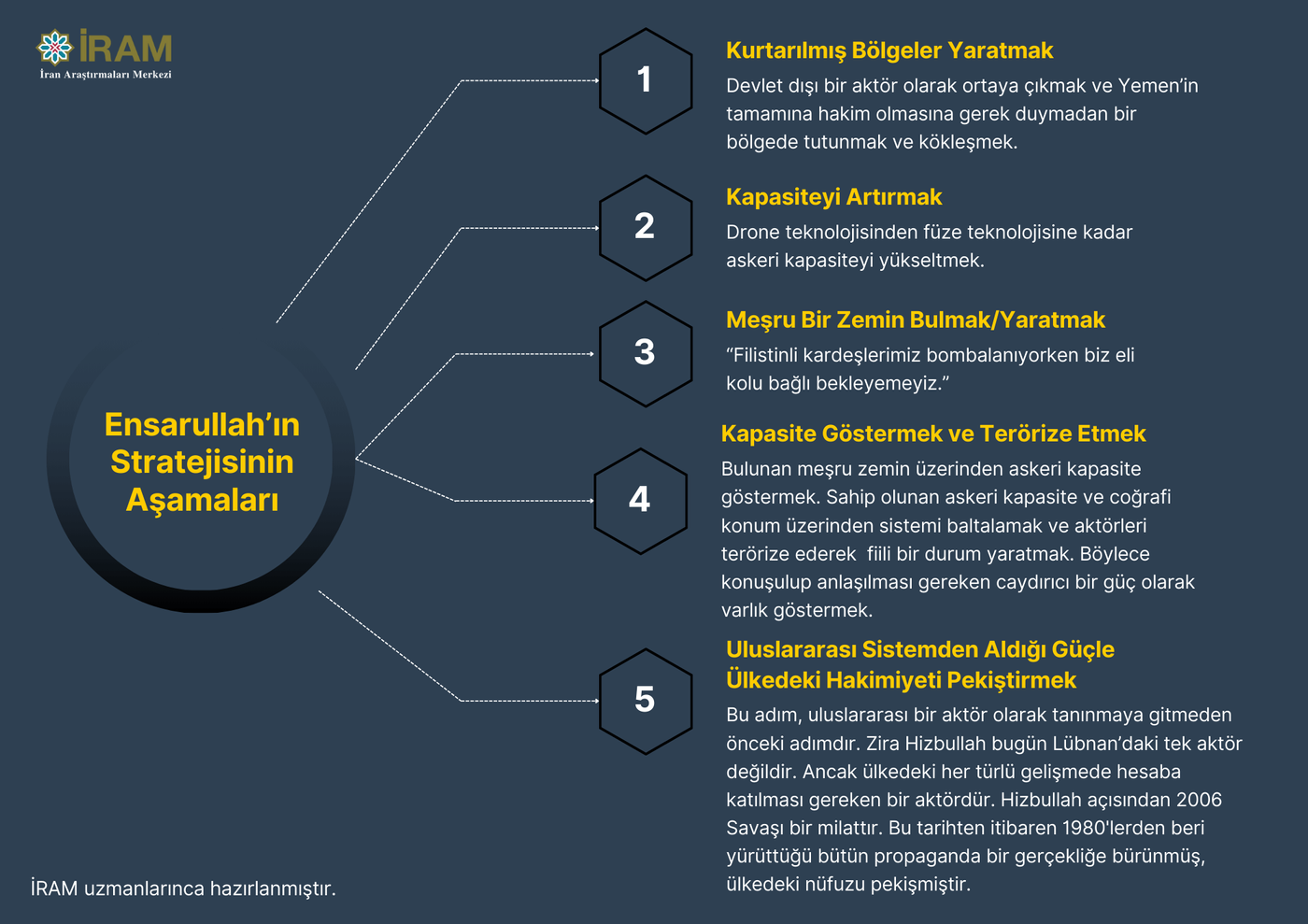
The Need for Status in Yemen as the First Step in a Larger Strategy
Ansar Allah was designated a terrorist organization in the final days of the Trump administration, then quickly delisted after the Biden administration took office, on grounds relating to the humanitarian crisis. For Iran, its recognition in Yemen as an independent actor in its own right, like Hezbollah, is strategically important. Every action there resonates globally, and linking every activity to Iran would eventually work against Tehran. As in Lebanon, Iran therefore wants to create a structure it can direct without being held responsible for it.
Iranian officials’ repeated claims that “we have no influence,” “decisions are taken independently of us,” and references to “mediation” are as old as the Islamic Revolution itself. Despite those words, events suggest two possible Iranian objectives, directly connected to each other. First, Iran, cornered by numerous sanctions, seeks to strengthen its hand for bargaining with global actors. Second, it seeks to complete Ansar Allah’s legitimization and bring it to a status similar to Hezbollah’s. In many places, the Houthis are already being described as “Yemenis” or “Yemeni militias,” creating the impression that they alone own Yemen. Recognition of Ansar Allah as a legitimate actor, and international acceptance of an expanded version of the existing de facto situation, would mean encircling Saudi Arabia from the south. Most importantly, Iran, which already wields power in the Persian Gulf, would gain a say over the Suez route, one of the world’s most important waterways.
The emphasis Iranian officials and the press have placed almost daily over the past year on expanding naval forces must also be considered. Iran clearly harbors ambitions concerning maritime trade routes. Even the Panama Canal was discussed last year. Military cooperation with strategically important countries such as Venezuela is also increasing. Alongside newly built ships, Iran is working intensively on unmanned maritime vehicles. In time, these will multiply the maritime influence of its regional proxies, particularly Ansar Allah and Hezbollah. Houthi activities can be seen as the first steps in Iran’s broader strategy of influencing maritime trade routes. It is entirely plausible that current events represent moves designed to test global powers in this regard.
This article was first published by the Center for Iranian Studies (İRAM) on January 16, 2024.
Link: https://www.iramcenter.org/iranin-ensarullahi-hizbullahlastirma-stratejisi-2445