


It can be argued that the Pezeshkian government is preparing for the approaching threat by consolidating the home front and reducing divisions within society as much as possible. Flexibility in both domestic and foreign policy is presenting Iran as a more rational actor while leaving Israel much more isolated. This can be considered another strategy Iran is pursuing against Israel, alongside its efforts to wear Israel down economically and in security terms.

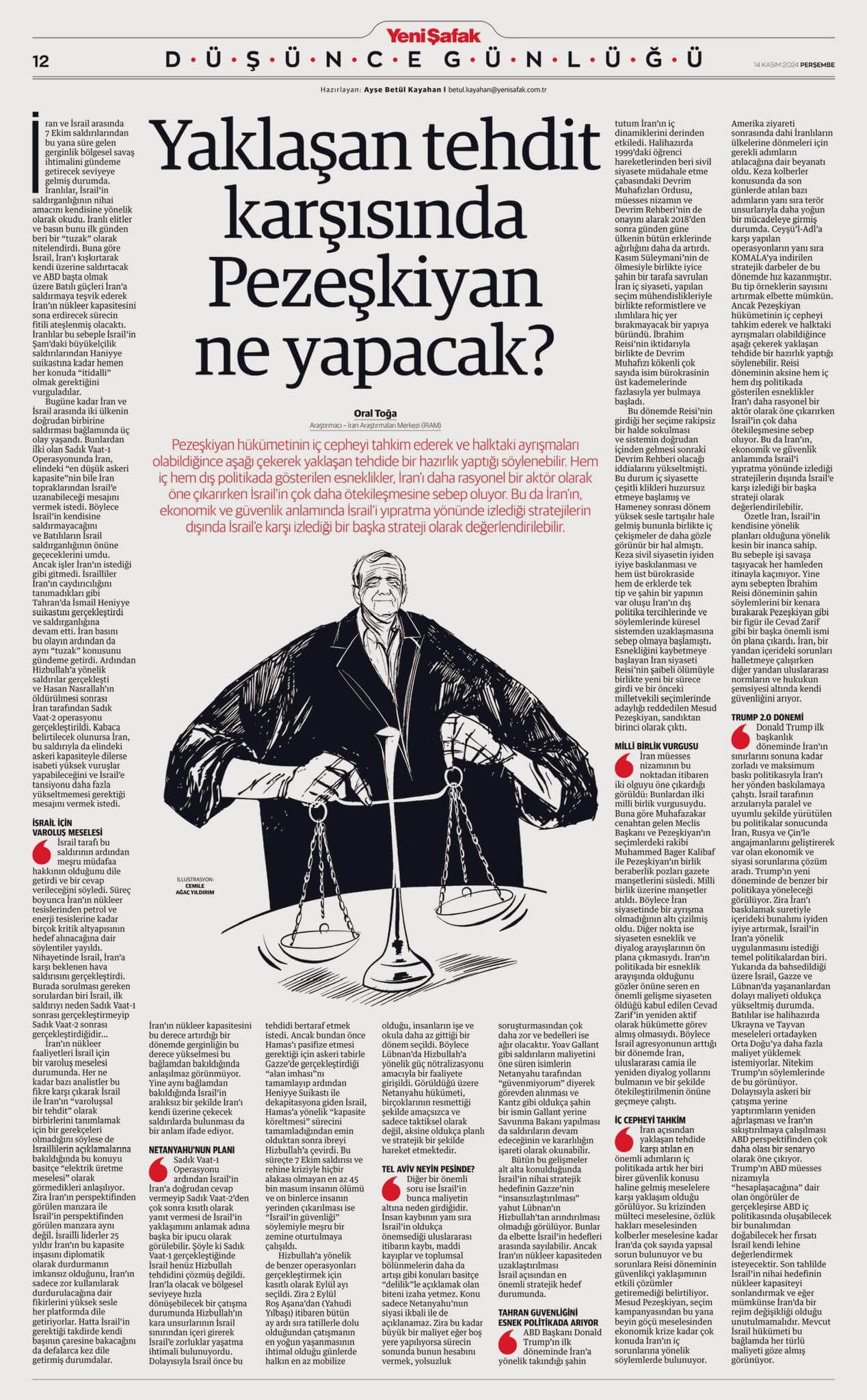
Illustration: Cemile Ağaç Yıldırım
The tensions between Iran and Israel that have persisted since the October 7 attacks have reached a level that raises the prospect of a regional war. Iranians have interpreted Israel’s aggression as ultimately directed at themselves. Iranian elites and the press have described this as a “trap” from the very first day. According to this reading, Israel would provoke Iran into attacking it, setting in motion a process that would encourage Western powers, particularly the United States, to attack Iran and put an end to its nuclear capacity. For this reason, Iranians emphasized the need for “restraint” on almost every issue, from Israel’s attacks on the embassy in Damascus to Haniyeh’s assassination.
To date, there have been three incidents involving Iran and Israel directly attacking each other. In the first, Operation True Promise I, Iran sought to send the message that even the “lowest military capability” in its possession could reach Israel from Iranian territory. It thus hoped that Israel would not attack it and that Western powers would restrain Israeli aggression. Events did not unfold as Iran wished, however. Not only did the Israelis refuse to recognize Iran’s deterrence, but they also assassinated Ismail Haniyeh in Tehran and continued their aggression. After this incident, the Iranian press again raised the same “trap” argument. Attacks on Hezbollah followed, and Iran carried out Operation True Promise II after Hassan Nasrallah was killed. Broadly speaking, with this attack Iran again sought to convey that its military capabilities allowed it to deliver highly accurate strikes if it wished and that Israel should not escalate tensions further.
AN EXISTENTIAL ISSUE FOR ISRAEL
After this attack, the Israeli side invoked its right to self-defense and said there would be a response. Throughout this period, rumors spread that numerous elements of Iran’s critical infrastructure would be targeted, from its nuclear facilities to oil and energy installations. Israel eventually carried out the anticipated airstrike against Iran. One of the questions that needs to be asked here is why Israel did not launch its first attack after True Promise I but did so after True Promise II...
Iran’s nuclear activities are an existential issue for Israel. Although some analysts reject this idea and argue that Israel and Iran have no grounds for defining one another as an “existential threat,” Israeli statements make clear that they do not regard the issue simply as a “matter of generating electricity.” The picture seen from Iran’s perspective is not the same as the one seen from Israel’s. For 25 years, Israeli leaders have stated loudly, on every platform, that it is impossible to stop Iran’s capacity building through diplomacy and that Iran can only be stopped by force. They have even said repeatedly that Israel will take care of itself if necessary. Viewed in this context, such a sharp rise in tensions at a time when Iran has increased its nuclear capacity to this extent does not appear inexplicable. From the same perspective, Israel’s continuous attacks designed to draw Iran into attacking it also make sense.
NETANYAHU’S PLAN
Israel’s failure to respond directly to Iran after Operation True Promise I, followed by a limited response long after True Promise II, can be seen as another clue to understanding its approach. When True Promise I took place, Israel had not yet dealt with the Hezbollah threat. In a conflict with Iran that could quickly become regional, Hezbollah’s ground forces might cross the Israeli border and cause difficulties for Israel. Israel therefore wanted to eliminate this threat first. But before doing so, it needed to neutralize Hamas. Having completed what it conducted in Gaza as “area destruction,” in military terminology, and then moved to decapitation through Haniyeh’s assassination, Israel turned its attention to Hezbollah once it was certain that the process of degrading Hamas’s capabilities was complete. During this process, the deaths of at least 45,000 innocent people and the displacement of tens of thousands who had nothing to do with the October 7 attack or the hostage crisis were presented as legitimate through the discourse of “Israel’s security.”
September was deliberately chosen for similar operations against Hezbollah. From Rosh Hashanah, the Jewish New Year, on September 2 onward, the entire month was filled with consecutive holidays. The chosen period was thus one in which the population would be least mobile and people would travel to work and school less during the days when fighting was most likely to be intense. An operation aimed at neutralizing Hezbollah’s forces was thereby launched in Lebanon. As can be seen, the Netanyahu government is acting in a highly planned and strategic manner, rather than aimlessly and merely tactically as many portray it.
WHAT IS TEL AVIV SEEKING?
Another important question is why Israel has taken on all these costs. Simply explaining the loss of international standing, which Israel values greatly, material losses, and deepening social divisions, in addition to the loss of life, as “madness” is insufficient to account for what is happening. Nor can the issue be explained solely by Netanyahu’s political future. If such enormous costs are being incurred for nothing, having to answer for them at the end of the process will be far more difficult than facing a corruption investigation, and the consequences will be severe. Netanyahu’s dismissal of figures such as Yoav Gallant, who highlighted the costs of the attacks, on the grounds that he “did not trust” them, and the appointment of a pronounced hawk such as Katz as defense minister in Gallant’s place, can also be read as a sign of determination and of the attacks’ continuation.
Taken together, all these developments indicate that Israel’s ultimate strategic objective is not the “depopulation” of Gaza or the removal of Hezbollah from Lebanon. These can, of course, also be counted among Israel’s objectives. But depriving Iran of nuclear capacity is Israel’s most important strategic objective.
TEHRAN SEEKS SECURITY THROUGH FLEXIBLE POLICY
U.S. President Donald Trump’s hawkish stance toward Iran during his first term profoundly affected Iran’s internal dynamics. The Islamic Revolutionary Guard Corps, which had already been seeking to intervene in civilian politics since the student movement of 1999, obtained the approval of the establishment and the Supreme Leader and, after 2018, increased its weight in every branch of the state day by day. Iranian domestic politics, which veered even further toward a hawkish position after Qasem Soleimani’s death, took on a structure that, together with electoral engineering, left no room for reformists or moderates. With Ebrahim Raisi’s rise to power, many figures from the Revolutionary Guards began to occupy a substantial number of senior positions in the bureaucracy.
During this period, Raisi’s unopposed entry into every election he contested and his emergence directly from within the system fueled claims that he would become the next Supreme Leader. This began to unsettle various domestic political factions; the post-Khamenei era started to be discussed openly, and internal rivalries became more visible. Meanwhile, the growing suppression of civilian politics and the presence of a uniform, hawkish structure in both the upper bureaucracy and the branches of government began to distance Iran from the global system in its foreign policy choices and rhetoric. Iranian politics, which had begun to lose its flexibility, entered a new phase with Raisi’s suspicious death, and Masoud Pezeshkian, whose candidacy had been rejected in the previous parliamentary election, emerged as the winner at the polls.
EMPHASIS ON NATIONAL UNITY
From this point onward, the Iranian establishment was seen to emphasize two things. The first was national unity. Images of solidarity between Pezeshkian and Mohammad Bagher Ghalibaf, the conservative speaker of parliament and Pezeshkian’s election rival, appeared on newspaper front pages. Headlines stressed national unity, underscoring that there was no division in Iranian politics. The other point was the prominence given to political flexibility and the pursuit of dialogue. The most important development demonstrating Iran’s search for policy flexibility was the return to an active government role of Javad Zarif, who had been considered politically finished. Thus, at a time of increasing Israeli aggression, Iran sought to rediscover avenues of dialogue with the international community and somehow prevent its own isolation.
CONSOLIDATING THE HOME FRONT
From Iran’s perspective, the most important steps taken against the approaching threat appear to concern its approach to domestic issues that have each become matters of security. Iran faces numerous structural problems, from the water crisis and the refugee issue to employment rights and the question of kolbars, and it is argued that the security-centered approach of the Raisi era failed to provide effective solutions. Since his election campaign, Masoud Pezeshkian has spoken about Iran’s internal problems on many issues, from brain drain to the economic crisis. Even after his visit to the United States, he stated that the necessary steps would be taken to enable Iranians to return to their country. Alongside some recent steps on the kolbar issue, Iran has also intensified its struggle against terrorist elements. In addition to operations against Jaish al-Adl, strategic blows against KOMALA have accelerated during this period. Many more examples could, of course, be given. It can nevertheless be argued that the Pezeshkian government is preparing for the approaching threat by consolidating the home front and reducing divisions within society as much as possible. Unlike during the Raisi era, flexibility in both domestic and foreign policy is presenting Iran as a more rational actor while leaving Israel much more isolated. This can be considered another strategy Iran is pursuing against Israel, alongside its efforts to wear Israel down economically and in security terms.
In short, Iran firmly believes that Israel has plans against it. For this reason, it carefully avoids every move that could lead to war. For the same reason, it has set aside the hawkish rhetoric of the Raisi era and brought a figure such as Pezeshkian and another important name, Javad Zarif, to the fore. While trying to resolve its internal problems, Iran is seeking security under the umbrella of international norms and law.
THE TRUMP 2.0 ERA
During his first presidency, Donald Trump pushed Iran to its limits and sought to pressure it from every direction through his maximum pressure policy. As a result of these policies, pursued in parallel and in harmony with Israeli wishes, Iran sought solutions to its existing economic and political problems by deepening its engagements with Russia and China. Trump appears set to pursue a similar policy in his new term. Intensifying the internal crisis by pressuring Iran is one of the principal policies Israel wants implemented against it. As noted above, Israel has driven costs considerably higher through the events in Gaza and Lebanon. Western powers, meanwhile, do not want to incur further costs in the Middle East while the issues of Ukraine and Taiwan are already on the table. This is also evident in Trump’s rhetoric. From the U.S. perspective, renewed tightening of sanctions and efforts to squeeze Iran therefore stand out as a much more likely scenario than military conflict. If predictions that Trump will “settle scores” with the U.S. establishment also materialize, Israel will seek to exploit in its favor every opportunity arising from a possible crisis in U.S. domestic politics. Ultimately, it must not be forgotten that Israel’s final objective is to end Iran’s nuclear capacity and, if possible, bring about regime change in Iran. The current Israeli government appears prepared to bear any cost in this context.
This article was first published on November 14, 2024, in the newspaper Yeni Şafak.