


What Is Composition?
Composition is the process of bringing different parts together to form a “whole.” The concept is used in many fields, including art, literature, music, and science. Etymologically, “composition” derives from the Latin verb “componere,” meaning “to put together.” That verb combines “com,” meaning “together,” with “ponere,” meaning “to place.” This Latin root later entered French as “composition.” Turkish borrowed both the word and its pronunciation from French.
In creative processes, composition means combining different elements in a particular order and harmony. In art, it involves arranging visual elements in works such as paintings, sculptures, and photographs; in literature, it involves structuring written texts. Musical composition creates melodies by arranging notes and rhythms in a particular order. In science and engineering, composition means combining substances or components in particular proportions to create new materials or systems. Across these fields, it plays a critical role in achieving both aesthetic and functional coherence. Put roughly, we might call it creating meaning by connecting one thing to another.
From everyday conversation to the unfolding of a film, the strength and flow of everything depend on how well it is composed. When a film is well composed, we are swept along and say, “I didn’t even notice it ending.” If music it is we are hearing, and its sounds are well composed, we “get carried away.” But if a film or book is poorly composed, we keep asking, “What does that have to do with anything?” and the experience becomes an ordeal. Personal conversations work the same way. We say of someone who brings events and words together well, “They speak like poetry,” or “Their conversation draws you in.” (By inverting the sentence to say “If music it is we are hearing,” I disrupted the flow. You probably had to read it twice to understand it.)
“Professor, I Can’t Follow What You’re Saying”
You are in class. Your teacher is talking about something, then suddenly changes the subject. “Hang on, what does that have to do with anything?” you think. In the teacher’s mind, there is a connection between the two subjects. But because you lack the knowledge needed to make it, everything becomes disconnected. Before long, you lose the thread of the lesson altogether. Similarly, if people cannot make the connections in something you write, do, or say, you eventually lose the attention of your audience, readers, and those around you. They look at their phones or start talking to the person beside them. The secret of good teaching, writing, public speaking, directing, architecture, composing, painting, management, and a good workplace lies in sound composition. Nothing is inconsistent or disconnected. Nothing is superfluous, and nothing is missing.
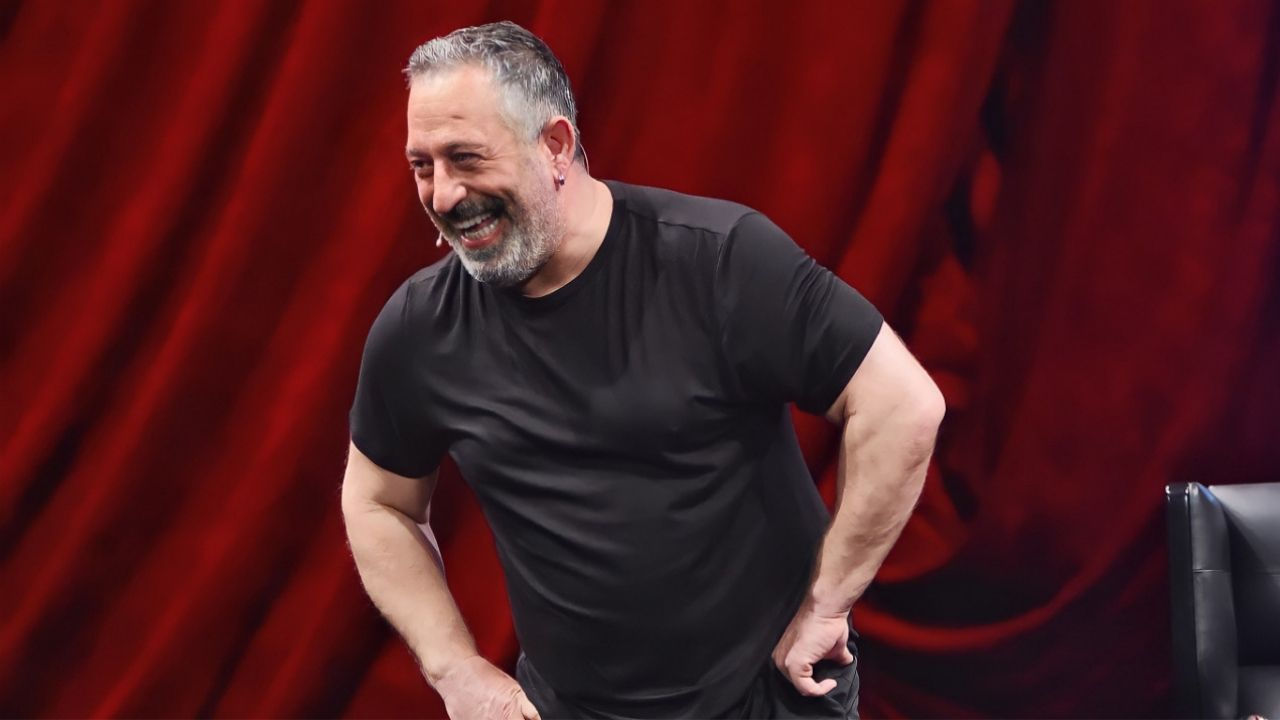
Cem Yılmaz’s Humor
You may well have read that heading and thought, “What does that have to do with anything?” That is precisely why I chose it. I now have very little time to retain my viewer’s, listener’s, or reader’s interest. Either I will compose this section so effectively that everyone says “Wow,” tickling their brains and affecting their emotional state, or I will fail to deliver and leave them asking, “What are you talking about?”
Cem Yılmaz’s humor has many dimensions: observation, imitation, wordplay, interaction, and more. He is someone who genuinely studies his craft. Although he uses material developed over months, he creates the impression of speaking spontaneously. This comes from the “authenticity” and “believability” essential to any good film or comedy. It hardly needs saying, but Cem Yılmaz is a true professional. What matters for our subject is this: the tracking mechanism.
The tracking mechanism is our brain’s ability to follow events and information in an orderly, predictable way. It gives us a sense of security and order in everyday life. The brain expects events to follow a particular logic and relaxes when that expectation is met. This mechanism allows us to make sense of and anticipate events around us, giving us a sense of security and control. Breaking that expectation—having events unfold unexpectedly—can capture attention and produce emotional reactions.
Another technique Cem Yılmaz frequently uses in his stand-up shows is to leave stories unfinished or move to a different story before reaching the expected conclusion. This continually engages and disrupts the audience’s tracking mechanism. The human brain expects a story or event to reach a natural ending once it has begun. Yılmaz deliberately frustrates that expectation, keeping the audience attentive and interested. Leaving stories unfinished creates ongoing uncertainty and curiosity. As viewers try to predict how one story will end, he moves to another, interrupting their predictions. This constant change and uncertainty repeatedly disrupts the tracking mechanism, heightening surprise, a fundamental element of humor.
As well as generating laughter, this technique keeps attention and interest high. Not knowing how a story will end, viewers remain focused, anticipating a new joke or surprise at any moment. This dynamic, unpredictable style keeps Yılmaz’s shows energetic and helps him form a strong connection with his audience. Even plain statements that would ordinarily produce barely a flicker of expression can provoke laughter when this mechanism is disrupted. Watch the opening of any of his stand-up shows: the first thing he does is begin speaking plainly in a way that breaks the mechanism. That is why people say afterward, “He talked about so much, but I can’t remember any of it.”
If I write five paragraphs about Cem Yılmaz and leave the subject there, I will merely have shown off information. Deciding how long or short to make something is an essential part of composition. It may be relevant, but if it goes on too long—or is too brief for the reader to make the connection—it has not been properly composed. After going on at this length, if I cannot bring the discussion back to the subject, I will merely have displayed information and disrupted the composition once again.
Even this explanation, presented as a large quotation, is intended to return to the subject and establish the composition. In fact, I deliberately stretched something I could have explained in one paragraph into five just so I could add the explanation above. I let the discussion wander. Here is another way I could have presented it: first, I could have briefly explained the importance of the tracking mechanism and its relationship to composition, then said, “Among other techniques, Cem Yılmaz disrupts the tracking mechanism to hold the audience’s attention and create humor. If you watch his shows, particularly their openings, you will see that he builds a narrative by jumping from one subject to another and leaving stories unfinished, or finishing them much later. You will notice that the audience begins laughing at everything. In short, disrupting the tracking mechanism can be a technique, but it is risky.” That would have been enough; five paragraphs were unnecessary. We should neither proceed in disconnected jumps like the teacher above nor drag things out as I have here. Every connection should be measured and proportionate.
Staring at a Blank Sheet of Paper
The writer Sidney Sheldon once said: “A blank piece of paper is God’s way of telling us how hard it is to be God.” When we put spontaneous speech onto a white page, things that did not trouble us and could be tolerated in conversation confront us with their meaninglessness. Every word must be chosen. Because writing is permanent, we cannot correct potentially misleading expressions as we do while speaking. There are no facial expressions, no tone of voice, no context supplied by the setting of a conversation, and so on. That is why producing a text is difficult at first. There are techniques for doing it. Let us turn to them.
Step 1: I Have an Idea!
You have probably thought about writing on a subject and found something you think you could write about. Immediately ask yourself:
- What do I want readers to feel or think when they finish? What is my message?
- Who is my audience?
- How timely and interesting is the subject?
- Do I have enough knowledge and expertise on the subject? If not, how much time do I need to research it? Is it a subject I can research? Can I access the sources within that time?
Let us examine these questions more closely:
What Do I Want Readers to Feel or Think When They Finish? What Is My Message?
First, let us look at the types of writing relevant to us:
- Academic writing: Scholarly articles, research reports, theses, and so on.
- Opinion pieces (op-eds): Articles published in newspapers or magazines expressing personal views and ideas on a particular subject.
- News reports: Newspaper, magazine, or online reports conveying current events and information.
- Columns: Articles published regularly by a particular writer in a newspaper or magazine, generally containing opinion and commentary.
- Blog posts: Pieces published on personal or institutional websites, generally with a more informal, personal tone.
- Literary writing: Artistic and creative work such as novels, short stories, poems, and plays.
There are many other types, including technical writing, scripts and dialogue, and instructional texts. I have included only these six.
As my use of the first person makes clear, what you are reading is a “blog post.” In preparing it, I wanted to produce something easy to read that explains the fundamentals of writing and composition without becoming too technical.
To make it accessible, I have written as though we were talking around a table. I am addressing an audience of people who want to write for KAF and trying to make the information as straightforward as possible to give them confidence. That directly affects the structure of the piece.
If you are composing a piece, you too must first establish its message: its main idea. Whenever you lose your way while writing, you can regain your bearings by asking, “Does what I am explaining fit with what I want to say?”
Who Is My Audience?
Identifying your audience is one of the most important questions. People who study history academically should not be told things like “Istanbul was conquered in 1453.” But if your audience knows nothing about Türkiye and was not educated there, any information about the country may be valuable. The same thing must be conveyed differently to different audiences. Ask yourself, “Who am I speaking to?” and “Who do I want to read this?” You will find the answers invaluable when choosing words, arranging information, and setting the level.
How Timely and Interesting Is the Subject?
Particularly if you are writing an op-ed, current topics can help you reach a broader audience. But if you are discussing something in your field of expertise or something you want to introduce, you may not need to wait for it to become topical. In other words, do not wait for seals to make the news before writing about seals. Still, when writing on academic subjects, current affairs, or developments in your field, understanding your audience’s needs and concerns will put you ahead.
Do I Have Enough Knowledge and Expertise on the Subject? If Not, How Much Time Do I Need to Research It? Is It a Subject I Can Research? Can I Access the Sources Within That Time?
No one is an expert on everything. Expertise is one thing; researching and learning about something you want to write about is another. Your audience matters enormously here. If you are writing for people with doctorates in physics and lack even a basic physics education, I suggest you leave that subject alone. I recommend particular care with academic content. Otherwise, you may be made to look foolish.
If, however, you are not claiming expertise and your intended readers are ordinary people, you can be more relaxed. I suggest working on subjects you know something about and could write on after a period of study. It helps you grow, and you learn a great deal while trying to produce the text. If you are starting from scratch on a subject you know nothing about, allow yourself time, seek expert input regularly, and do your reading. Follow up the questions that emerge with expert advice, requesting appointments and having conversations with specialists. Many experts will be pleased that their subject is attracting interest. Do not hold back out of shyness or hesitation. Do not be afraid to knock on doors. Someone working in the field can offer insights that many books cannot.
Once you have answered these questions, we can move to the second part.
Step 2: A 1,000-Piece Jigsaw
You have sat down, read books and articles, consulted artificial intelligence, sought out an expert, and now face a mountain of data. Every fact and piece of information is a jigsaw piece. Building a larger picture requires good composition. Otherwise, the information and data in your writing will be scattered like belongings in a messy room. It becomes overwhelming.
At this point, I want to discuss the data hierarchy very briefly. I have prepared a table below. The hierarchy moves from raw data to information, then knowledge, and finally wisdom or insight. At its lowest level is data: raw, unprocessed facts. Data becomes information when processed and organized in a particular context. When that information is analyzed and interpreted to develop a deeper understanding, it reaches the level of knowledge. Finally, wisdom emerges when accumulated understanding and knowledge are used in strategic thinking and sound decision-making. The hierarchy plays a critical role in knowledge management and decision-making.
The Data Hierarchy

- Data:
Definition: Raw, unprocessed facts and figures. Without context, they have no meaning on their own.
Characteristics: Numbers, texts, symbols, observations, and so on.
Example: 101, “Ali,” “May 23, 2024,” temperature readings. - Information:
Definition: Meaningful content obtained by processing and organizing data in a particular context.
Characteristics: Data becomes information through analysis and contextualization.
Example: “Ali attended a meeting in Room 101 on May 23, 2024.” This sentence organizes individual data points in a meaningful way. - Knowledge:
Definition: The process of internalizing information and identifying patterns and relationships on that basis.
Characteristics: Knowledge develops through experience and education. It includes the ability to apply information effectively.
Example: “Ali’s pattern of attendance at meetings may affect his performance on particular projects.” - Wisdom:
Definition: A deep grasp of information and knowledge, used to guide future decisions and actions.
Characteristics: Wisdom includes strategic thinking, foresight, and sound judgment.
Example: “Ali’s regular attendance at meetings should be encouraged to improve the team’s long-term productivity.”
During research, we gather information and data. We connect the information and make the data meaningful, allowing a picture to emerge. This is just like assembling a jigsaw. We sort pieces of similar colors into groups, then build the picture according to how they fit. Seeking expert advice and reading or watching experts’ work can give us clear indications of what the picture is, or might be, because a genuine expert has internalized knowledge and attained wisdom.
Step 3: We Have Gathered Data and Information. What Now?
As I have just noted, first establish your aim and audience, then classify the data and information accordingly. Let us simplify it further. Suppose you are writing an essay—or preparing a speech—that requires no research or data collection. You simply want to express your feelings and thoughts. Your subject is “red”: you will write about “red.” You stare at a blank sheet, and it stares back. What exactly will you write? On a separate sheet, you could draft a classification of your thoughts and feelings as follows:

You can apply this simple method of classification even to academic texts. That is what research notes, filing systems, and the like are for. Once you have classified the material, you can build a piece around your goal, selecting information, data, or subjects one by one. Think of them as building materials. You will construct a building by choosing each brick, steel beam, and pane of glass. In the next step, I will explain how to put them together.
Step 4: Connecting One Thing to Another
Words connect within a sentence, sentences within a paragraph, paragraphs within a section, and sections within a book or article. They are composed into a whole like stitches in embroidery. Let us look at that embroidery.
First, take a paragraph.
It is good for a paragraph to contain at least five sentences. There is no point writing two sentences and moving to a new paragraph. Sentences should be consistent with one another and connected in form or meaning, as I will demonstrate. Everything that needs to be said in a paragraph should be said before moving to a new topic. That is why giving each paragraph a small, unwritten heading can be a lifesaver. Suppose you are writing a ten-paragraph op-ed on the security dimension of migration in Türkiye. You have gathered and classified your data; your idea and audience are clear. Set out headings like these:
- Paragraph: Introduce the subject. Explain why you are addressing it. Ask the main question. Explain what the piece covers.
- Paragraph: Briefly discuss the history of migration in Türkiye.
- Paragraph: Discuss the current situation in Türkiye and present the statistics you have collected.
- Paragraph: Explain the concept of securitization.
- Paragraph: Explain that the humanitarian and security dimensions of migration must be treated separately, but that doing so is very difficult. Discuss why.
- Paragraph: Discuss the areas in which migration has been securitized in Türkiye.
- Paragraph: Discuss the security problems created by migrations throughout history.
- Paragraph: Draw parallels in light of the data and information you have found.
- Paragraph: Discuss statistical and survey studies, supporting your previous argument with scientific evidence.
- Paragraph: State your conclusion plainly and explain why you have said all of this.
As you can see, in two minutes I have outlined an opinion piece on a subject I made up on the spot. Notice how the paragraphs connect and how I gradually bring the discussion toward the point I want to make. I have built the skeleton. Now it needs flesh.
Let us turn to the connections between the sentences in a paragraph.
Because migration is a technical subject, I will not write a paragraph about it. Instead, I will build a composition from a seemingly nonsensical text on an entirely different subject. I have prepared the example below as a table:
Text:
The weather is beautiful today. I used to love walking on days like this. One such day, I went out for a walk. I saw her there before me. How could I have known that walk would change my life so much? Today, though, as I walk in this beautiful weather, all I feel is a great emptiness. I simply walk. The weather is beautiful; inside, I am cold.
I made up this passage while writing this article. It took less than twenty seconds. The paragraph’s first sentence is “The weather is beautiful today.” Its last is “The weather is beautiful; inside, I am cold.” Without the connection between them, if I simply placed those two sentences together, you would ask, “What is going on?” and lose the thread. Let us discuss why you did not. What, technically, did I do?
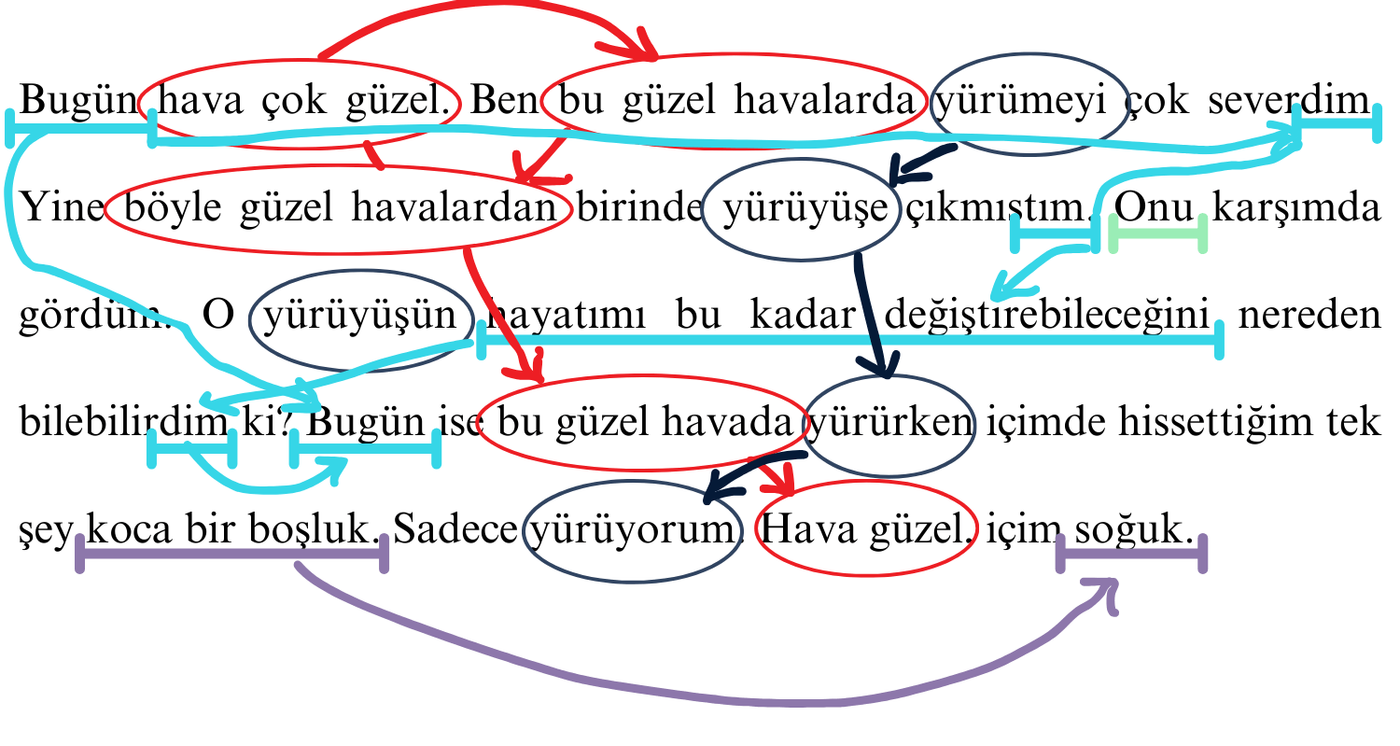
As this rather complicated example shows, I sometimes repeated the same word directly in the next sentence. Follow the red markings. I keep saying that the weather is beautiful, making a concrete connection with what I want to describe next. The light-blue markings show a relationship involving time and change. The weather is beautiful today, but I “used to love” it, implying that something has changed. I do not say “I love.” I am preparing the reader for what follows. The next sentence begins “One such day...” as I move into a story and ends with my having gone out for a walk. In the following sentence, I get to the point: “I saw her.” I have composed a connection between “walking,” “beautiful weather,” and “her.” Then, by asking how seeing her and her presence in my life could have changed everything, I suggest that there is a long story here, and that it did not end happily. I then reconnect the past to the present with “Today, though, as I walk in this beautiful weather,” before turning to my feelings and describing the emptiness inside. That supports what I hinted at in the previous sentence. Next, I make the language a little more poetic to intensify the emotion: “I simply walk. The weather is beautiful; inside, I am cold.” The contrast between the pleasant weather and the coldness within is intended to elicit an emotional response: sadness. Through imagery, I conjure up a person walking alone, filled with longing. This is the moment when the reader responds, “Oh, man...” Yet my first sentence merely said the weather was beautiful. Seven sentences later, I have provoked an emotional response. The power of words...
For comparison, let me tell the same story without composing it.
Text:
The weather is beautiful today. I saw Ayşe while walking. I like walking in beautiful weather. Ayşe changed my life a lot. How could I have known, when I saw her, that my life would change so much? I am walking again. I miss Ayşe very much.
Something is different, isn’t it? That is because it has not been composed. This is really what questions about paragraph structure are testing. But that is another subject. Let us not disrupt this piece’s composition by going into it.
In short, once you can compose effectively, you can take a discussion anywhere and convey any thought in any way. That is where style and method come in.
Step 5: What Kind of Style Is That?
Method is everything. Even well-intentioned things can get you into trouble if done improperly. That is why everything must be done according to its method. Lawyers do not say “procedure comes before substance” for nothing. Even cooking eggs with sucuk requires following the proper method. Method is mathematics; it does not change. Just as two plus two equals four, the eggs do not go into the pan before the sucuk. First the sucuk browns, then the eggs are cracked in. Otherwise, the dish does not work. Texts have a mathematics of their own. Disrupt it, and the result is no more than a heap of information. (Notice that I brought the discussion from eggs with sucuk back to writing. If you can compose effectively, you can talk about sucuk or lawyers’ sayings alike.)
Another issue as important as method is style. Style is connected to a piece’s message and purpose. If you want to stir readers while telling a heroic story, you choose one set of words; if you want to anger them, you choose another. You construct your sentences accordingly. Muallim Naci discusses tender and harsh words. Tender words are delicate and polite. “Ali died,” for example, is a plain statement. Instead of “died,” however, you could say “passed away,” “went to God,” or “received God’s mercy.” In doing so, you convey to the reader or listener the emotions carried by those words. You could also say “met his Maker,” “croaked,” “went to donkey heaven,” “kicked the bucket,” or “had cotton stuffed up his a**”... The list goes on. Isn’t the feeling conveyed by these words clear? That is how important word choice is.
If you are writing an academic text, I suggest avoiding emotionally loaded words. Say what you think plainly. Vague, ambiguous language should also be avoided. Expressions such as “many,” “some,” “a little,” and “thing” are empty words. Do not use them. “Some things are very bad” says nothing. “Interrupting others and failing to listen is very bad” conveys a direct, clear message. Keep away from the former. If you are not writing an academic text or an opinion piece, you can feel freer, but still be careful. Remember that you are painting pictures in people’s minds. If you use the wrong words and contexts to express something, you have not expressed it.
A second consideration is sentence structure. Contrary to what we may think, the order of sentence elements directly conveys feelings and thoughts. Many people imagine themselves incomprehensible, secretive, mysterious. Yet aesthetic values, what they find beautiful, how they dress, the symbols they wear—all of these are a language and say something. Their mouths may be silent, but what makes them laugh or cry, their haircut, their chosen colors, the way they shape their eyebrows, and the outfit they choose from thousands all communicate something. Equally important are intonation and the order of elements in a spoken sentence. Context, too, is at least as important in distinguishing meaning; I will return to it. In Turkish, emphasis generally falls on the element immediately before the final one. Let us imagine that a friend comes up to you and says the following—shown here in English translation, with the emphasis preserved:
I saw you yesterday during a walk on the beach.
I saw you during a walk on the beach yesterday.
I saw you yesterday during a walk on the beach.
I saw you yesterday during a walk on the beach.
I saw you yesterday during a walk on the beach.
Each sentence conveys a different feeling. Every emphasis reveals what matters most to us in the sentence and what we most want to highlight. We emphasize accordingly, whether the important element is time, place, or person.
A third, and one of the most important, elements is context: the specific conditions, circumstances, or environment in which an event, situation, expression, or idea occurs, develops, or exists. Context is crucial to understanding information correctly and completely. A sentence’s meaning, for example, may change depending on the setting, the relationship between the speakers, and the purpose of the conversation. Likewise, interpreting a historical event correctly requires understanding the political, economic, and social conditions of its time.
Interpretations and decisions made without considering context are generally incomplete, incorrect, or inappropriate. Properly evaluating research findings, for example, requires considering the study’s design, sample, and limitations. Similarly, effective communication with people from different cultures requires understanding and respecting each culture’s particular values, norms, and traditions. The ability to understand context is therefore vital to drawing sound conclusions, making appropriate decisions, and communicating effectively.
Some examples:
- Language and communication: Words and sentences can change meaning according to their context. “Very warm,” for example, can mean different things when describing the weather or a person.
- Literature and art: Interpreting literary and artistic works generally requires understanding the historical, cultural, and social context in which they were created.
- History: To understand historical events correctly, it is important to know the political, economic, and social conditions of their time.
- Research and academia: Interpreting research findings correctly requires consideration of the study’s context, including its sample, methodology, and limitations.
- Business and management: Effective decisions and actions require an understanding of the organization’s internal and external context, including market conditions, competitors, and resources.
- Intercultural communication: Effective communication with people from other cultures requires knowing and respecting their particular contexts: values, norms, traditions, and so on.
By Way of Conclusion
Good composition and design are vital to every undertaking, system, and work. Few things can stand in the way of a well-designed, well-composed system. A well-composed artwork gives great pleasure. I believe we should even compose our personal lives well, carefully weighing the harmony, contexts, and subjects linking things and events. Reading contexts and connections can be a lifesaver. It makes reaching our goals easier.