
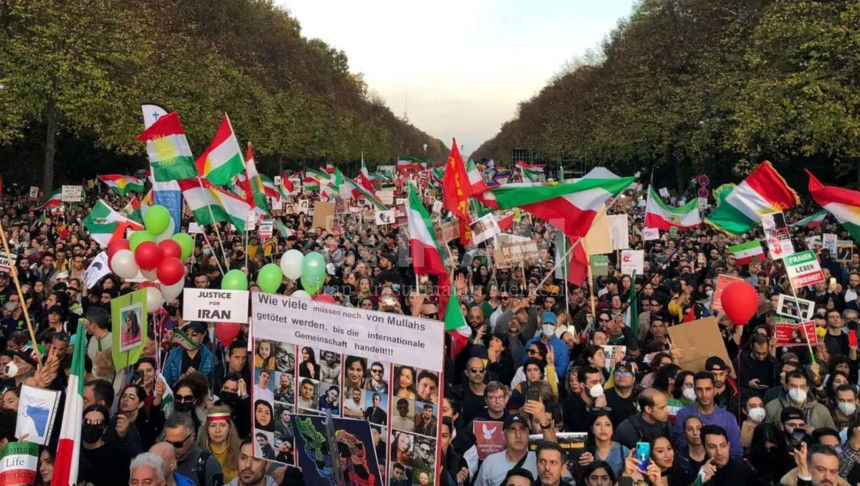

On 28 December 2025, protests triggered by the economic crisis in Iran’s capital Tehran spread across the country within days, prompting the Iranian opposition in the diaspora to mount a comprehensive mobilization. From the first day of the protests, Iranian communities in the United States, Canada and Europe began organizing coordinated actions, and the wing gathered around the exiled crown prince Reza Pahlavi gained particular visibility.
Immediately after the protests began, Reza Pahlavi launched an intensive communication campaign through social media and Western outlets. In his first comprehensive statement, posted on X on 1 January 2026, he described the Iranian regime as being at “the weakest, most divided and most fragile point in its history” and called on the international community to “stand with the Iranian people not only in word but in deed.” On 2 January, following US President Donald Trump’s remarks on Iran, he issued a message of thanks. In a Persian-language video message he called on the people of Tehran to march into city centres “in small and cohesive groups of friends.”
5–6 January marked the peak of Pahlavi’s visibility in Western media. In an interview with the Wall Street Journal he developed a line that departed from his posture during the twelve-day conflict, opposing outside military intervention with the words “change in Iran is ultimately in the hands of the Iranian people.” At the same time he assessed that “the regime is collapsing; no special operation is needed for that.” In an article published in the Washington Post he noted that protesters were chanting his name alongside their calls for freedom and national unity, but stressed that he carried this “not as a claim to power, but as a profound responsibility.” In the same piece he referred to a transition plan called the “Iran Prosperity Project” and to an “Emergency Handbook” prepared with more than a hundred experts. All of this indicates that Pahlavi has taken account of the accusations of “collaboration” and of “coming to power on someone else’s strength” levelled at him over the calls to revolt he issued while Iran was being bombed during the twelve-day conflict, and that he has changed his strategy.
On 6–7 January, Pahlavi issued his first concrete call to action over the protests. He asked for coordinated chanting at 8 p.m. on the evenings of 8 and 9 January, with the message: “whether in the streets or from your homes, start shouting at exactly this hour.” He sent a separate message to the security forces, asking them “which side of history will you stand on,” and claimed that “thousands of regime members” had joined the National Cooperation Platform established six months earlier. Speaking on Fox News’ Hannity programme, he said “in all these years I have never seen an opportunity in Iran like the one today.” This call was described by some groups within the diaspora as “irresponsible.” In their view it carried the potential to put demonstrators’ safety at risk. Cases in which Iranian security forces have in the past detained people on the basis of footage shared on social media, and in which such processes are alleged to have ended in death, were cited as the grounds for this criticism.
Organizational Infrastructure and Media Network
Behind Pahlavi’s appeals lies an institutional structure built up over the years. The Iran National Council (INC), founded in Paris in 2013 and also maintaining an office in Woodland Hills, California, stands out as the organization that functions as Pahlavi’s political platform. The Phoenix Project (a reference to the Simurgh) was launched in 2019 at George Washington University as a think tank. It aims to develop post-regime plans in the fields of energy, the economy, security and agriculture. The National Union for Democracy in Iran (NUFDI), a Washington-based non-profit, carries out policy advocacy. With 105,000 followers on Instagram, the organization published an “Emergency Transition Government Plan” in July 2025 designating Pahlavi as “Leader of the National Uprising.” They also run a large troll army.
In terms of media infrastructure, the London-based Iran International and the Los Angeles-based Manoto TV, both broadcasting in Persian, covered the protests intensively. Pahlavi stated that if the internet were cut off, “communication would continue through the hundreds of thousands of Starlink devices in Iran and through the Iran International and Manoto channels.” On the question of Starlink terminals, a US-based non-profit called NetFreedom Pioneers (NFP) has played an active role, receiving roughly 150,000 dollars in funding from the US government. Former NASA executive Firouz Naderi called on the diaspora to raise 600,000 dollars for 1,000 terminals. As of January 2026, more than 100,000 Starlink users are estimated to be in Iran.
The Geography of Diaspora Demonstrations
After the protests began, the diaspora staged coordinated demonstrations worldwide. Almost all of them, however, were held by groups of 50 to 100 people. These demonstrations did not come close even to the scale of the protest held in Berlin during the 2022 Mahsa Amini demonstrations. At a rally organized on 31 December 2025 by the Organization of Iranian American Communities (OIAC) in front of the White House in Washington DC, regime change was demanded. On 1 January, hundreds of Iranian-Canadians demonstrated in Richmond Hill (Greater Toronto), with Pahlavi’s advisers also taking part. 3 January was a coordinated day of action for the diaspora. In London, roughly a hundred people gathered outside Downing Street chanting “Javid Shah” (Eternal/Immortal Shah) and “Woman, Life, Freedom,” with participants from the Jewish community carrying Israeli flags. In Berlin, supporters of the People’s Mojahedin Organization demonstrated outside the Iranian embassy. In Washington DC, around 500 people gathered in front of the diplomatic mission known as the Iranian Interests Section.
On 4 January, demonstrations continued in Cologne, Stockholm, Copenhagen and Oslo. In Canada, joint demonstrations by Jewish and Iranian communities in Vancouver, Winnipeg and Toronto drew attention. In the second week, on 6 January, NCRI/MEK supporters held a rally in Oslo, and Pahlavi’s call for coordinated chanting on 8–9 January found wide resonance in the diaspora. In the United States, Los Angeles, Washington DC and San Francisco stood out as the main centres. Beverly Hills Mayor Sharona Nazarian said: “Beverly Hills is home to one of the largest Iranian communities outside Iran. We see you, we hear you and we stand with you.” In Canada the Jewish-Iranian alliance was particularly visible, with Israeli and Iranian flags carried side by side in Toronto and Vancouver.
In Israel, the government offered open support. Mossad announced “we are with you not only from afar and in words, but on the ground as well,” and Prime Minister Netanyahu said “we identify with the struggle of the Iranian people.” In Britain, separate demonstrations took place. The Anglo-Iranian Women’s Association gathered in Downing Street, while Pahlavi’s supporters assembled outside the Iranian embassy.
Divergent Perspectives Within the Diaspora
Within the diaspora, the various opposition factions displayed differing attitudes towards the protests. The monarchist wing brought to the fore the slogans “Javid Shah” (Eternal/Immortal Shah), “This is the last war, Pahlavi will return” and “Reza Shah, bless your soul.” Flags bearing the Lion and Sun emblem were the dominant element in this group’s actions.
The People’s Mojahedin Organization / National Council of Resistance of Iran occupied a different position. The organization’s leader Maryam Rajavi described the protests as “a sign of the Iranian people’s determination to be rid of religious tyranny.” As of 5 January the Resistance Council reported 31 deaths and “warned” the security forces that “the courts of a free Iran are waiting for them.” The organization did not recognize Pahlavi as leader and presented its own “Resistance Units” as the backbone of the protests.
The Kurdish opposition sought to present a collective front. On 7 January, seven major Kurdish parties, chief among them the Democratic Party of Iranian Kurdistan (KDPI), Komala and PJAK, issued a joint declaration. The declaration condemned the regime’s crimes in Kermanshah, Ilam and Luristan and called for a general strike. As this is a stance that has been taken several times before, it is not an exceptional development. The Kurdish groups demanded federalism and autonomy and kept their distance from Pahlavi. According to the 2024 GAMAAN survey, Pahlavi’s support in the Kurdish regions is below 20 percent. PJAK warned that “monopolism, opportunism and political manipulation would undermine the movement.”
Republican and secular voices, for their part, took a position against both theocracy and monarchy with the slogan “Neither Shah nor mullah.” This group foregrounded the demand for a democratic republic, and some analysts claimed that monarchist media were manipulating footage of the protests.
Conclusion
All opposition factions found common ground on the end of the Islamic Republic, support for the protesters and condemnation of regime violence. On 2 January a broad coalition of activists issued a joint declaration. Even so, the question of leadership remained the most critical area of conflict. While Pahlavi claimed a representative role, the other factions rejected it. The monarchy-republic dilemma constituted the fundamental ideological divide; federalism was a sine qua non for the Kurdish groups, while centralist tendencies remained strong on the monarchist side. His relations with Israel have also distanced Pahlavi from many opposition figures.
In sum, the Iranian diaspora responded to the 28 December protests rapidly and on many fronts. Reza Pahlavi emerged as the most visible opposition voice in Western media and sought to give direction to the protests through calls for coordinated action. Yet the deep divisions within the diaspora (monarchists, the MEK, Kurdish groups, republicans) prevented the emergence of a common leadership. According to the 2024 GAMAAN survey, Pahlavi’s support as an individual leader stands at 31 percent, the highest among opposition figures but far from a majority. Whether the diaspora can overcome this fragmented structure in the period ahead will be as decisive as the course of the protests themselves. Finally, it is also difficult to say that a large share of the Iranian people is aware of what is going on in the diaspora.
This article was first published in IRAM on January 8, 2026.