


Human presence in Anatolia dates back 12,000 years, as material remains such as Göbeklitepe demonstrate. From the Hattians and Hittites to the Ionians and Persians, many peoples, cultures, and faiths have touched these lands. Paganism, Zoroastrianism, Christianity, Islam, and many other religions and denominations have existed here in all their variety. Diversity has consequently become one of Anatolia’s most fundamental characteristics. Amid the nineteenth century’s homogenizing ideas and events, first the revolt in the Morea and then the Crimean War drove large Muslim populations into the Balkans and Anatolia. The mass expulsion of Circassians from the Caucasus subsequently brought further forced migration to Anatolia.
The Circassians’ experience can be traced even in Tanzimat-era novels: a great tragedy lies behind the recurring “Circassian girl” among their enslaved characters. Later events uprooted hundreds of thousands of Muslims from various Balkan ethnic groups in as little as fifteen days. European powers’ rhetoric and social friction then suggested that a process similar to those in the Caucasus and Balkans might develop in Anatolia. The events of 1915 followed, and afterward the Greek–Turkish population exchange imposed mutual forced migration. Whether these state decisions were right or wrong is outside this article’s scope, so their political and humanitarian dimensions will not be discussed.
Before all this strife, Anatolia, the Balkans, and the Caucasus possessed a rich, varied social fabric. Armenians were undoubtedly one of its cornerstones. According to the accounts, they are an Indo-European people who entered Anatolia through the Balkans. Of Thraco-Phrygian descent, they were, in Herodotus’s account, a branch of the Thracian-origin Phrygians that moved toward Urartu. Pressure from the Illyrians—Albanians—led them into eastern Anatolia in the sixth century BCE. There, they mixed with remnants of earlier peoples such as the Urartians and Hurrians, and with Caucasian peoples, forming today’s Armenian community.
They call themselves “Hay” (Հայ) and their country “Hayastan” (Հայաստան). “Armenian,” by contrast, derives from Old Persian and first appears as “Arminiya” in Darius I’s Behistun inscription near Kermanshah, Iran, around 520 BCE. Concentrated in the Achaemenid Empire’s satrapy, or province, of Arminiya, Armenians maintained relations with Iranians for centuries. The satrapy grew increasingly important and witnessed power struggles late in the Achaemenid period. Alexander’s destruction of that empire created a vacuum in which kingdoms of various sizes emerged. Two Armenian kingdoms appeared, one in the Aras Valley and another in Elazığ. Armenians also formed part of states such as the Kingdom of Pontus centered on Amasya.
Armenians identify themselves as “the first people to become Christian” and take genuine pride in this, a fundamental cornerstone of identity. Saint Gregory the Illuminator, or Surp Krikor Lusavorich, must also be mentioned because of his great importance. After a difficult life, he introduced Armenians to Christianity, which they officially adopted under his leadership in 301. They therefore called him Lusavorich, “the Illuminator.” The “Gregorian” denomination followed by most Armenians likewise takes its name from Saint Gregory, or Surp Krikor.
Like every society, Armenians are not homogeneous or defined by one monolithic identity. Armenian identity encompasses groups differing in religion, language, and political outlook and interpretation. The Hayhorom, this article’s subject, are an intriguing strand within that diversity.
As noted, “Hay” means Armenian. “Horom” (Հոռոմ) is the Armenian word for a Byzantine Greek, or Rum, referring to Eastern Romans—the Byzantines—and sharing the conceptual framework of Turkish “Rum.” “Hayhorom” can thus be translated roughly as “Armenian Rum” or “Roman Armenians.” They speak Armenian but belong directly to the Greek Orthodox Church: in essence, they are Eastern Romans. Although small groups lived in central and eastern Anatolia, particularly around Tokat, they were concentrated in Eğin, known in Armenian as Agn and today called Kemaliye in Erzincan. “Agn” means a spring or water source in Armenian and became “Eğin” in Turkish. Another substantial community lived around Geyve and is also thought to have come from Eğin.

The Hayhorom did not know Greek. They used Armenian at home and school and celebrated church services in it. Their priests likewise did not speak Greek; only ecclesiastical headgear, objects, and literature belonged to the Greek Church. According to Arsen Yarman, the Badarak liturgy was translated from Greek into Armenian and chanted using Greek Orthodox chant modes. Only the hymns Havadamk and Surp Asdvadz were sung in Greek, which the congregation did not understand. Gregorian Armenians called them “Dzat Hayer” or “Armenyak,” meaning “half-Armenian.” This offers another indication of the importance Gregorian Armenians attached to denomination and religion within their identity.
Yarman, citing Armenian historian Arshak Alboyajian, also suggests that the Hayhorom may have adopted Greek Orthodox rites because of Byzantine assimilation policies or the circumstantial advantages of Orthodoxy. Armenians outside the Greek Orthodox Church faced heavy taxation and military obligations, leading some to join it and embrace Orthodoxy.
More intriguing are the claims of Yorgos I. Anastasiadis. He says the Hayhorom did not know Greek but spoke Armenian and Karamanli Turkish. In 1896, he reports, Karamanli hymns were sung more frequently in their churches. If true, this could be important evidence of far more complex Anatolian interactions and exchanges than generally imagined. Their character, scale, and underlying causes deserve scholarly examination. If the claim is correct, the presence of Karamanli rather than Greek, despite the geographical distance, is thought-provoking.
Anastasiadis discusses three intriguing theories of their origins. First, they were Armenians who chose Orthodoxy amid religious divisions and gradually came to regard themselves as Rum. Second, they descended from the Greek mercenaries described by Xenophon, who fought for Cyrus’s attempt to seize the Persian throne in 401 BCE and sought to return after his death. On this theory, they were Greeks left behind during the “Return of the Ten Thousand” who became Armenian over time. The last theory rests on their concentration in Eğin: its name supposedly derives from Aegina, near Athens, and the Hayhorom were colonists from there who founded the town. Yarman regards this as the weakest theory, because Eğin derives from Agn, meaning “spring” in Armenian, as noted above.

Two American missionaries, Eli Smith and Harrison Gray Otis Dwight, visited in 1830 and published their observations in Missionary Researches in Armenia in 1834. Pages 274–275 of the English work’s second volume say the following about the Hayhorom:
“There is now a small Hayhorom community in Agn, north of Arapgir and west of the Euphrates. We met one of them in Etchmiadzin, a banker and one of the most gentlemanly Armenians we had encountered. He told us his birthplace lay thirty hours from Diyarbakır, thirty from Sivas, and sixteen from Maden. There were five villages in the area, all Armenian-speaking but affiliated with the Greek Church, with their own metropolitan under the Greek Orthodox Patriarch in Constantinople. He said they had enjoyed many privileges under the Turkish state. When the Russians came to Erzurum, however, an uprising occurred, and they had suffered much persecution since. Another source said their church books were Armenian, and when visiting Jerusalem on pilgrimage, they attended Armenian services against Greek wishes because they understood Armenian but not Greek. The small clan of Agunsti, or the Armenians of Agn, are well known, particularly as bankers. Some are among the richest in that profession in Constantinople. We have heard of no other Armenian community belonging to the Greek Church.”
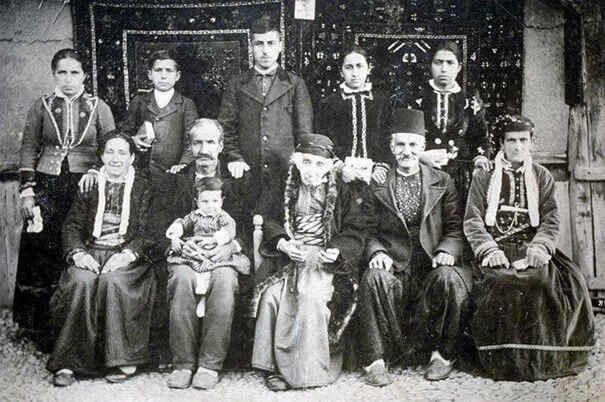
The term “half-Armenian” suggests differences of identity and some divisions between Hayhorom and Gregorian Armenians. One account says some Armenians fleeing the 1915 deportation into the mountains faced extreme hardship in winter and decided, despite every risk, to return to their villages. The Hayhorom themselves prevented their resettlement, having taken possession of the property they left behind. Although the Hayhorom may not have been expelled in 1915, they soon shared the Karamanli Turks’ fate in the 1923 exchange with Greece and were sent there. Naturally, the property they had seized did not benefit them either. They settled in Kastaniotissa, in the municipality of Istiaia-Aidipsos on Euboea, establishing what they called “New Eğin Village.” They remain there today.
In conclusion, the Hayhorom and their cultural heritage have disappeared, sharing a fate similar to that of the Karamanli Turks. Sources consequently offer little satisfying information. Very few written and visual traces remain.