


Internal migration is the movement of individuals from one region to another within their own country. It takes four forms: rural-to-rural, rural-to-urban, urban-to-rural, and urban-to-urban. It is triggered by factors at macro, meso, and micro levels. Movements driven by regional inequalities or major events such as natural disasters and wars are categorized at the macro level; those shaped by family decisions and social networks fall at the meso level. The micro level is more personal, reflecting people’s expectations of life, current needs, and efforts to fulfill future plans.
Particularly common in developing countries, internal migration has returned to prominence in Iran in recent years amid drought and economic problems. It is, in fact, a decades-old issue there. Since the second half of the last century, migration within the country has fluctuated but remained continuous. Urbanization, land reform, industrialization, agricultural decline, and, particularly in the 1980s, the Iran–Iraq War have been its main drivers. Studies report that approximately 250,000 people moved from rural to urban areas during the 1960s and 1970s, predominantly because of land reforms and rapid industrialization in major cities. In the 1980s, the eight-year war with Iraq displaced approximately 2.5 million Iranians internally. In the 1990s, the concentration of social services and job opportunities in cities encouraged rural-to-urban migration, with an estimated 180,000 people leaving their homes during this period.1 Today, the water crisis, unemployment, and related factors are the principal drivers.
These major demographic shifts, together with substantial population growth in the latter half of the twentieth century, played a major role in rapid urbanization. Iran now has one of the Middle East’s highest urbanization rates. The urban share of the population rose from 31 percent in 1956 to 54 percent in 1986, over 69 percent in 2006, and 74 percent in 2016 (Table 1). Eight provinces have populations above one million, while eighteen have more than half a million. With approximately nine million inhabitants, Tehran is becoming a megacity where not only population but also resources, services, employment, and investment are concentrating disproportionately and rapidly, widening regional inequalities. Growing regional socioeconomic disparities are thought to have fueled migration to Tehran in recent years and reinforced uneven population growth between regions. The government has accordingly implemented programs supporting rural areas and small and medium-sized cities to encourage movement toward the regions and reverse migration from Tehran.2
Table 1: Iran’s Urban Population Share Over Time

Source: Statistical Center of Iran, 2016
As Iran has urbanized, urban-to-urban migration rose from 40 percent of internal migration in 1976–1986 to approximately 70 percent in 2011–2016 (Table 2). Rural-to-urban migration fell from 32 to 15 percent, while rural-to-rural migration also declined (Sadeghi, 2020, p. 308). Given that most Iranians live in cities, this change is unsurprising.
Table 2: Percentage Shares of Internal Migration Types3
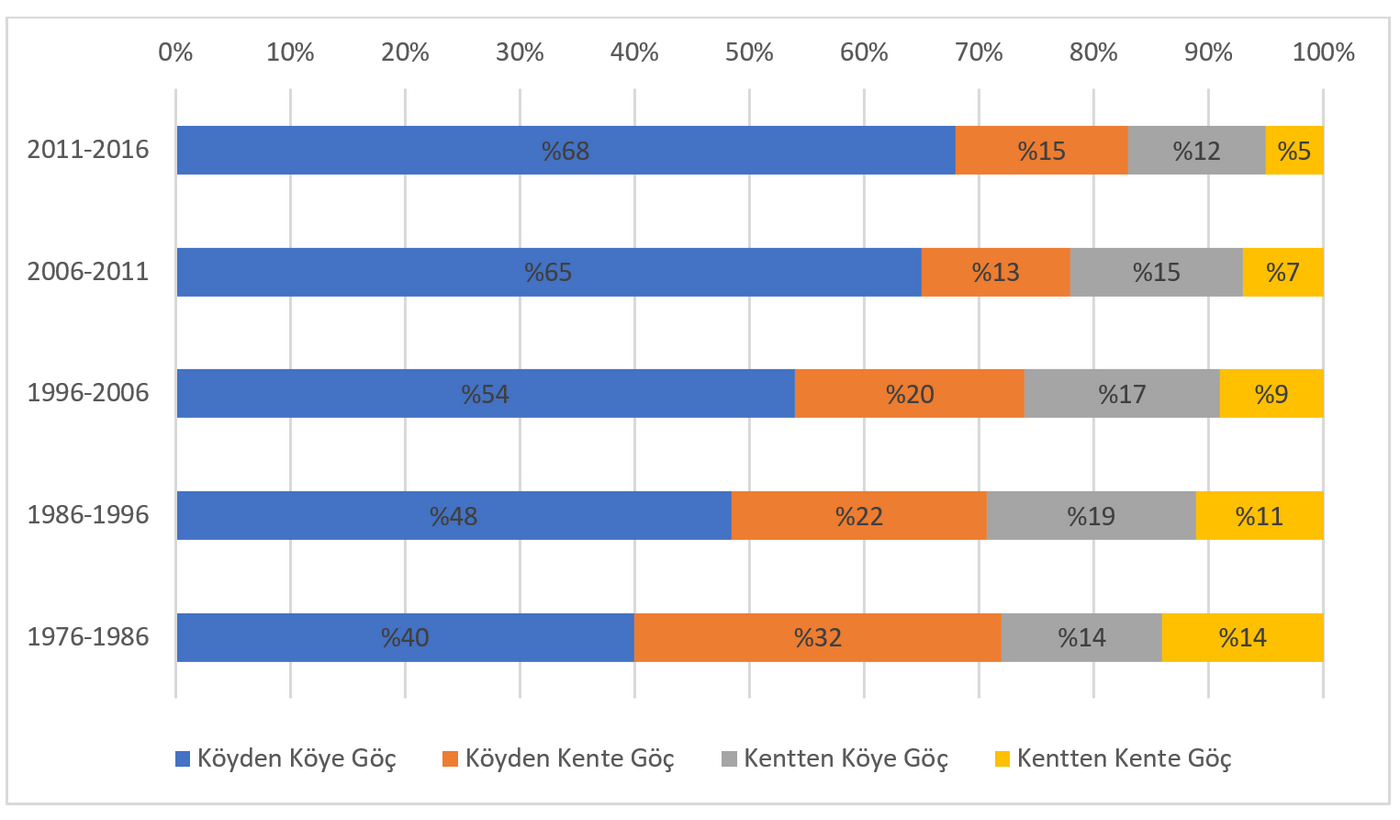
Source: Sadeghi, 2020, p. 309
Directions and Causes of Internal Migration in Iran
The regions with the greatest outflows can be divided into three groups. The first lies in the west and southwest: Khuzestan, Lorestan, Kermanshah, and Hamadan are among the main sources of migrants, who mostly settle in Tehran and Isfahan. The second comprises West Azerbaijan, East Azerbaijan, and Ardabil, whose migrants generally head to Tehran and Gilan. The third consists of South Khorasan, Kerman, and Sistan and Baluchestan, whose migrants move to Mashhad, Yazd, and Isfahan. Studies confirm migration from less-developed areas to centers such as Yazd, but also show that these serve as stepping stones toward larger provinces such as Tehran and Alborz.
Alongside major destinations such as Tehran, Isfahan, and Mashhad, northern Iran is now receiving internal migrants. Broadly, there is a south-to-north flow. The favorable climate and natural environment of provinces such as Gilan and Mazandaran are contributing to population growth. Mahmoud Moshfegh, head of demography at Allameh Tabataba’i University, has noted that population is increasing not only in Tehran but also around the Caspian Sea, potentially creating new environmental and ecological problems. Growth in receiving provinces also triggers economic and social difficulties. According to Moshfegh, migrants no longer move to Tehran or Karaj, but buy land and housing in smaller surrounding cities such as Pardis, Shahriar, and Pakdasht, pushing prices upward.
In addition to migration northward, southern coastal provinces, including Bushehr and Hormozgan, have experienced net population gains, particularly because of oil, petrochemical, and industrial development. Migration there is mainly from smaller to larger cities, making it urban-to-urban in character. High urbanization among people aged 18–35 has reduced rural-to-urban migration’s share of all movements. Movement from small towns to major cities is therefore more dominant.
At meso and micro levels, families and young people in rural areas and small towns seek better lives through greater employment or higher-education opportunities in major cities. Migration is most common among those aged 18–35. Military service, higher education, taking up or seeking work, and marriage are major reasons. Male migration is shaped predominantly by military service and employment, while female migration is mainly associated with family and education. By age, migration peaks in the mid-twenties and then declines. Studies also show that internal migration stabilized at a moderate level over the past decade. In the five years to 2016, more than 3.4 million Iranians moved between cities, two million between provinces, and 1.3 million between regions.4
Internal Migration Driven by the Water Crisis
Drought is among the most important drivers of internal migration today. Water-shortage crises in provinces with major basins, such as Khuzestan and West Azerbaijan, will produce crises and transformations at various levels in the near, medium, and distant future. Water shortages, drought, and associated sandstorms harm life in many ways. Economically, sectors from industry to agriculture and livestock farming are affected. These difficulties have begun turning into intense protests, as in Khuzestan and Isfahan. People facing growing hardship and unemployment are turning to internal migration.
Assessment
Internal migration has not yet become a “national security issue” in Iran. Drought, severe economic conditions, and increasingly apparent resource scarcity alongside population growth, however, could set large populations in motion in the medium term. Moreover, migration may well be directed toward Türkiye rather than remain within Iran. A wave from West Azerbaijan, which borders Türkiye and suffers particularly severe drought and social tension, appears quite possible.
Another adverse consequence is the growth of deprived urban settlements. Alongside this, crime and unemployment rise in parallel with provincial social, economic, and demographic imbalances, making cities less safe and creating conditions for unrest. Rural development, investment and budget allocations for small and medium-sized cities, more youth employment particularly in western and eastern provinces, and fair access to services such as health and education would have positive long-term effects. So would policies to reduce poverty and economic inequality and achieve a more balanced spatial distribution.
1 Resul Sadeghi et al. (2020). “Internal Migration in Iran”. Internal Migration in the Countries of Asia, Switzerland: Springer, p. 313
2 Resul Sadeghi et al. (2020). “Internal Migration in Iran”. Internal Migration in the Countries of Asia, Switzerland: Springer, p. 296
3 Based on census data from 1976–1986 to 2011–2016.
4 Resul Sadeghi et al. (2020). “Internal Migration in Iran”. Internal Migration in the Countries of Asia, Switzerland: Springer, pp. 295–317.
This article was first published by the Center for Iranian Studies (İRAM) on January 27, 2022.
Link: https://www.iramcenter.org/iranda-ic-goc-684