


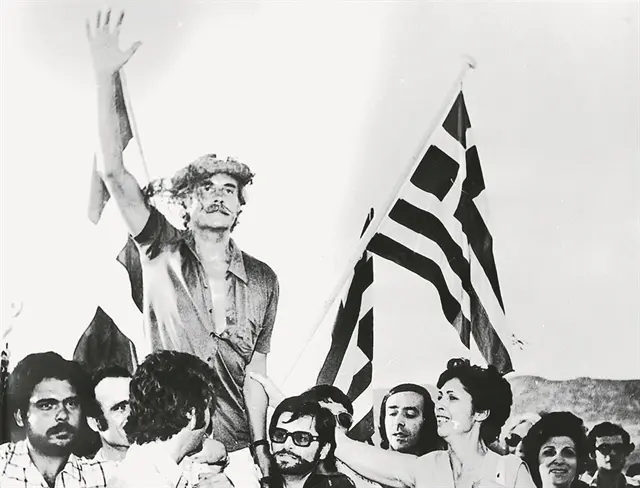
The fundamental parameters of contemporary Greek politics were shaped in the post-1974 period known as the Metapolitefsi (Μεταπολίτευση, Regime Change). The collapse of the seven-year military junta was followed in short order by the abolition of the monarchy, the legalisation of the Communist Party and the establishment of the two main pillars of the party system that still operates today. The ideological map of today's Greek parties, the basic patterns of voter behaviour and the traditional framework of political competition have remained largely tied to this founding moment.

A brief look at the pre-1974 period brings the following picture into view. Immediately after the Second World War, Greece was the scene of a civil war fought between 1946 and 1949 between communist guerrillas and the royal army, a conflict that claimed hundreds of thousands of lives and shaped the country's political memory for decades. The 1950s and 1960s passed under a right-leaning parliamentary regime, with the monarchy embedded as an institutional actor at the centre of politics. The 1967 Colonels' Junta began with the military taking direct control of government and lasted until 1974. The bloody suppression of the student uprising at the Athens Polytechnic (Πολυτεχνείο, Polytechneion) in November 1973 deepened the regime's legitimacy crisis, and the Cyprus intervention of July 1974, together with the junta's inability to manage that crisis, accelerated its collapse. Konstantinos Karamanlis's return from exile in Paris and the restoration of civilian government took place in this conjuncture.
For half a century the system operated essentially through two large blocs. The centre-right New Democracy (Νέα Δημοκρατία, ND) and the centre-left PASOK alternated in power between 1981 and 2009, while the influence of third parties remained marginal. The 2010 debt crisis upended this order. SYRIZA was transformed from a small radical-left party into a candidate for government, PASOK lost much of its electoral base and the populist right carved out a space of its own. As of May 2026, with new party launches announced in quick succession, this balance has once again entered a process of reshaping.
Electoral System
Understanding the shape of Greek politics requires beginning with the logic of the electoral system. The threshold for entry into the 300-seat Hellenic Parliament (Βουλή, Vouli) is set at 3%, allowing several smaller parties to find representation. The truly decisive feature, however, is the so-called reinforced proportional mechanism. Once the leading party reaches a certain share of the vote, it benefits from a seat bonus of up to 35 seats; once it crosses the 40% threshold, a single-party majority becomes virtually inevitable. This system was abolished in 2016, reintroduced in 2019 and last amended in 2020.
This structure has historically rendered coalition governments the exception. The traditional practice of Greek politics has been built around single-party government. Coalitions have either emerged in crisis conjunctures, as in the 2011 Papademos technocratic government or the 2012 Samaras cabinet, or carried a strained and provisional character, as in SYRIZA's 2015-2019 partnership with ANEL (ΑΝΕΛ, Ανεξάρτητοι Έλληνες, Independent Greeks). Political debates therefore tend to revolve not around whether ND can be overtaken, but around what share of the vote ND will receive.
Nea Dimokratia
New Democracy is the main centre-right umbrella party founded in the post-junta period. Konstantinos Karamanlis founded it in 1974; the founding leader had served as prime minister between 1955-1963 and again between 1974-1980, and subsequently held two terms as president. Following the collapse of the junta, Karamanlis returned from exile in Paris, oversaw the constitutional referendum and steered Greece into European Community membership. The party's ideological DNA is derived from this founding moment. A liberal-conservative European orientation, a market-oriented inclination to reduce the economic weight of the state, an emphasis on holding firm within NATO and the EU, and a political tone aligned with the Orthodox Church without being directly religious are among the core components of its identity.
ND's leadership line has followed this path. Konstantinos Karamanlis led the party from its founding until 1980; after a brief transitional period, his nephew Kostas Karamanlis served as prime minister between 2004 and 2009. Antonis Samaras held the coalition premiership in 2012-2015 and the party leadership through the 2010s, Vangelis Meimarakis served briefly as interim leader, and from 2016 onwards the party has been led by Kyriakos Mitsotakis. Mitsotakis is also the son of Konstantinos Mitsotakis, ND prime minister between 1990 and 1993. The distinction between father and son sharing the same surname is often blurred in written texts; the father Mitsotakis era belongs to the 1990s, the son Mitsotakis era to the 2020s.
Between 1981 and 2009 the sharing of the stage between ND and PASOK operated almost mechanically. With the brief exception of the 1990-1993 father Mitsotakis government, PASOK remained in office between 1981 and 1989, then through short coalition periods and the 1996-2004 Simitis era, while ND returned to power between 2004 and 2009 under the nephew Karamanlis. The two parties competed as alternatives to one another, with third parties confined to a role of merely collecting protest votes. This thirty-year balance dissolved with the 2010 debt crisis. Yorgos Papandreou's having to disclose to the EU, as prime minister, the concealed budget deficit, the imposition of austerity packages and the start of troika supervision triggered the unravelling of PASOK's base. In the 2012 elections PASOK fell from 44% to 13%, and in the subsequent election dropped to single-digit support.
Kyriakos Mitsotakis took over the premiership in 2019 and secured a second term with a single-party majority in 2023. A Harvard graduate and former McKinsey consultant, Mitsotakis has projected a profile closely tied to the financial markets and has made economic performance ND's principal political argument over the past six years. Greece has left behind the post-crisis era, its credit rating has returned to investment grade, tourism records have been broken and growth rates have run above the EU average. Nonetheless, the largest shadow over ND remains the 2023 Tempi train disaster and the public anger that has followed.
On 28 February 2023, near Larissa, two trains collided; at least 57 people lost their lives, with a significant share of the victims being university students. The immediate aftermath revealed systemic problems including decades of neglected railway infrastructure, a non-functioning signalling system and the inadequate training of the stationmaster. The ND government's initial response leaned on a narrative of individual fault, foregrounding the stationmaster, and public opinion did not accept this framing. Allegations that evidence had been lost during the bureaucratic investigation and that scene-of-incident tampering had occurred further raised expectations of accountability. Mass demonstrations have been held on each anniversary over three years, and Maria Karystianou, one of the relatives of the victims, has emerged as the spokesperson of this movement. As of 2026, the Tempi case remains an open wound for ND, and the new party founded by Karystianou on 21 May 2026 symbolises the direct entry of this grievance into politics.
PASOK

PASOK, in full Panellinio Sosialistiko Kinima (Πανελλήνιο Σοσιαλιστικό Κίνημα), in English the Panhellenic Socialist Movement, was founded in 1974 by Andreas Papandreou. Papandreou, who had been an economics professor in the United States and spent his exile years there, built the party's base around anti-Turkish positioning and Third World rhetoric. The 1981 elections marked the first experience of the left in government in Greek history and are regarded in the literature as the moment when the Metapolitefsi was truly completed. PASOK in power meant the expansion of social-state institutions, a significant rise in public employment, a transition from populist Euroscepticism to a clearly pro-EU line over time, and the institutionalisation of political clientelism. Greek public administration operated through the patterns PASOK established throughout the 1990s and 2000s.
The party's leadership has followed this line. Andreas Papandreou served as leader between 1974 and 1996, Kostas Simitis between 1996 and 2004, and Yorgos Papandreou (the son of Andreas) between 2004 and 2012. Evangelos Venizelos led the party between 2012 and 2015, and Fofi Gennimata between 2015 and 2021. Gennimata died of cancer while in office, and Nikos Androulakis was elected leader in December 2021. A politician from Heraklion (Crete) with experience in the European Parliament, and roughly twenty years younger than Mitsotakis, Androulakis came to the leadership at a moment when a major issue was about to shake the country. In 2022 it emerged that his phone had been tapped using Predator spyware, triggering the most serious security-services controversy ND has faced.
PASOK's political maturity arrived under Kostas Simitis. Prime minister between 1996 and 2004, Simitis adopted a technocratic and pro-European profile in contrast to the populist tone of Andreas Papandreou. Greece joined the eurozone during his tenure, and the planning for the 2004 Athens Olympics also took place in this period. Yet the claims that public finance indicators had been reported differently from reality in order to secure euro membership formed the structural backdrop of the subsequent debt crisis, and this criticism continued to hang over PASOK throughout the 2010s.
PASOK's post-crisis trajectory has unfolded as gradual decline followed by a long recovery. From 44% in office in 2009 it fell to the 4-5% band in 2015, coming close to falling out of parliament. Reorganised as KINAL/PASOK-Movement, the party recovered roughly 12% in the 2023 elections, a level it had not reached in seven years. The decisive leap came in November 2024. After SYRIZA's collapse, Androulakis took over the parliamentary leadership of the main opposition, an event that combined symbolic rebirth with concrete political gain. According to May 2026 polling, PASOK is running in the 14-15% band and now stands as the only serious alternative to ND. Tsipras's new party, however, has the potential to compress precisely this political space.
SYRIZA

SYRIZA's trajectory through the 2010s constitutes the most important transformation in post-Metapolitefsi Greek party politics. Its full name is Synaspismos tis Rizospastikis Aristeras (Συνασπισμός Ριζοσπαστικής Αριστεράς), the Coalition of the Radical Left. Founded in the 1990s as a small coalition of communist-origin parties, SYRIZA entered parliament with 4.6% in 2009. Over the next three years its vote rose from 4% to 27%, and in the January 2015 elections it emerged as the first party. Alexis Tsipras became prime minister at the age of 40, formed a coalition with the right-populist ANEL (ΑΝΕΛ, Independent Greeks) and tested a strategy of brinkmanship in debt negotiations with the EU.
July 2015 was among the most intense weeks in Greece's post-war history. Tsipras put the terms of the third bailout package imposed by the EU and IMF to a popular referendum and won 61% for the Oxi (Όχι, No) vote on the ballot. The result settled symbolically into the deep memory of the Greek left. Within seven days, however, Tsipras had to sign the conditions just rejected at the polls, and the process is referred to in the Greek literature as the capitulation. SYRIZA's identity crisis, which still echoes today, bears the imprint of this seven-day cycle. The party shifted from radical-left rhetoric toward pragmatic social democracy and remained in office for four more years through 2019 as a left government implementing austerity.
Defeated by ND in 2019 and again in its second defeat in 2023, SYRIZA entered a new period after Tsipras's resignation. In September 2023, the unexpected figure Stefanos Kasselakis was elected to the party leadership. Kasselakis, then 35, was a Wharton graduate with a Goldman Sachs background who had lived in the United States. With prior Republican Party affiliation in the US, a same-sex marriage and a social-media-driven populist style, Kasselakis's profile drew the party base into a deep split. In November 2023 eleven MPs and three MEPs left the party and founded Nea Aristera (Νέα Αριστερά, New Left). In September 2024 the SYRIZA central committee passed a vote of no confidence in Kasselakis, and in the leadership election held in November 2024 Sokratis Famellos was elected party president. Kasselakis founded his own party, Kinima Dimokratias (Κίνημα Δημοκρατίας, Movement for Democracy), in December 2024. Through this process the pre-2023 SYRIZA base now stands divided across three structures: SYRIZA, Nea Aristera and Kinima Dimokratias.
In May 2026 polls SYRIZA is running at around 4%. Once a party of government, SYRIZA today trails KKE, having also lost its position as parliamentary main opposition to PASOK. Famellos continues efforts to consolidate the party, but the conjuncture appears difficult. Tsipras's formal announcement of his new party on 26 May 2026 is expected to mean further bleeding of votes for SYRIZA.
KKE
KKE, in full the Communist Party of Greece (Κομμουνιστικό Κόμμα Ελλάδας, Kommounistiko Komma Elladas), has been continuously active since its founding in 1918. Following its defeat in the Civil War it remained banned until 1974, regaining legal status under Karamanlis. General Secretary Dimitris Koutsoumbas has held the post since 2013. KKE is one of the important parties in Europe still maintaining an orthodox Marxist-Leninist line. While most of the European left turned to Eurocommunism or social democracy after the collapse of the Soviet Union, KKE did not follow this trajectory, has openly opposed EU and NATO membership and has not engaged in cooperation with European socialist groupings.
The party's stable vote share runs between 6 and 8%. Though small, the figure is exceptional for an orthodox communist party in an EU member state. KKE's base is disciplined and the internal party structure tightly knit. The importance of the party is not limited to its share of the vote; its weight in trade unions, university youth organisations and social struggle arenas runs considerably higher than its electoral figure. A proper reading of Greek politics requires accounting for KKE's structural presence.
Right-Wing Populism
The right edge of Greek politics has gone through a substantial reshaping in recent years. Golden Dawn (Χρυσή Αυγή, Chrysi Avgi) was at one point parliament's third-largest party with 7-8% of the vote, and was declared a criminal organisation by court ruling in 2020, with its leaders sentenced to prison. Three structures have moved into the vacuum. The first is the Greek Solution (Ελληνική Λύση, Elliniki Lysi) led by Kyriakos Velopoulos, a populist, nationalist party with strong anti-Turkish positioning that has grown on the back of Covid-era scepticism. The second is Niki (Νίκη, Victory), a conservative party close to the Orthodox Church and targeting religious voters, which crossed the 3% threshold in 2023 and entered parliament. The third is Spartiates (Σπαρτιάτες, Spartans), a far-right formation in which former Golden Dawn supporters have regrouped. According to May 2026 polling trends, Elliniki Lysi is in the 9% band, Niki around 2% and Spartiates outside parliament.
The common feature of these three structures is that they draw less from the traditional ND base and more from crisis victims, rural voters, small traders and Church-aligned constituencies. The constant pressure they exert on ND's right flank has pushed the Mitsotakis government to manoeuvre rightward rather than toward the centre on migration, identity politics and Church affairs.
Left Fragmentation
The fragmented appearance of the left is the most distinctive feature of present-day Greek politics. Four mid-sized parties are currently active on the left; SYRIZA has been discussed above, and a brief summary of the others is in order. Plefsi Eleftherias (Πλεύση Ελευθερίας, Course of Freedom) was founded by former SYRIZA MP and former parliament speaker Zoe Konstantopoulou. It adopts a populist-left style, with a focus on law and justice, and has placed the Tempi case at the centre of its line. In May 2026 polls it is in the 8% band and has now overtaken SYRIZA. Nea Aristera (Νέα Αριστερά, New Left), founded by MPs who broke from Kasselakis-era SYRIZA, is a more academically toned left party and runs at around 1.5%. MeRA25 (ΜέΡΑ25, Μέτωπο Ευρωπαϊκής Ρεαλιστικής Ανυπακοής, Front of European Realistic Disobedience), founded by former finance minister Yanis Varoufakis, represents the euro-critical left and hovers around the parliamentary threshold. Kinima Dimokratias (Κίνημα Δημοκρατίας, Movement for Democracy), Kasselakis's own party, polls at around 2%.
The fragmentation of the Greek left does not stem solely from personal disputes or leadership contests; a deeper structural matter is at play. A party that came to power on a promise to resist austerity (SYRIZA) ended up implementing those very policies, durably eroding the trust of a significant portion of left voters in politics. This opening gave rise to a number of smaller formations, since no single leader or party can credibly claim to represent the entire left constituency any longer. Plefsi Eleftherias with its justice-focused tone built around the Tempi case, Nea Aristera with its effort to preserve an intellectual register, and MeRA25 with its euro-critical line each appeal to distinct segments of the left electorate. If the left's combined roughly 25-28% vote share could be gathered under a single roof, it would constitute a direct challenger to ND. The current fragmented picture provides a conditional advantage to PASOK, though PASOK is itself unable to absorb the entirety of these potential votes, since while representing the centre-left it does not carry the symbolic legacy of the radical left.
Karystianou and Tsipras: May 2026 Moves
As of May 2026, two new party announcements are once again unsettling the Greek political landscape. On 21 May, Maria Karystianou announced the founding of her own party. The mother of one of the victims of the 2023 Tempi train disaster, Karystianou has been the public face of a movement that has mobilised civic conscience over three years. Her programme has not yet been fully clarified, but its core axis appears to be built around accountability, judicial reform and the state's conduct toward ordinary citizens. Polling under the name Foní Logikís (Φωνή Λογικής, Voice of Reason) already places it in the 3.5% band. The figure is not small; even before the party's formal launch, its measured base already stood above the parliamentary threshold.
The second move is on a much larger scale. On 26 May, Alexis Tsipras will formally announce his new party. Working under the slogan "Now is the time", the former prime minister is pursuing a strategy of reclaiming the umbrella of the left bloc. If he succeeds in pulling his base together again, he has the potential to draw in the remaining SYRIZA vote, the left wing of PASOK and even parts of the Nea Aristera and Kinima Dimokratias cadres. The success of this move could on its own determine the shape of the 2027 elections. Should it fail, the fragmented picture of the left would become a settled fact and ND's position as an unrivalled force over the next decade would be all but secured.
The Current Picture and Turkey's Perspective
The current picture can be summarised under a few headings. ND maintains a steady course in the 30% band, holds office in its second term and stands as the clear favourite for the 2027 elections. PASOK is trying to defend its position as main opposition against Tsipras's move. SYRIZA, divided into three, fights for survival around 4%. KKE holds its accustomed base of 7-8%. Right-wing populism is scattered across three pieces, with a combined weight of roughly 10%. Left fragmentation produces a dispersed picture in parliamentary arithmetic despite a combined 25-30% vote share. The two new party initiatives have made the system even more mobile.
From the Turkish perspective, the importance of the Greek party system stands out at the following point. To read Athens's foreign-policy decisions merely as the personal preference of the prime minister is a misleading approach. The Turkey policy of ND and PASOK governments does not fundamentally differ; both parties share a line of strategic deterrence, of containment through the EU and of leaning on the language of international law. Tonal differences can be observed, but the overall framework remains largely unchanged. The rise and fall of the left, on the other hand, has been reflected differently in the Turkey file. The Tsipras government of 2015-2019 sought to strike a pragmatic line with Turkey, the Mitsotakis era saw the relationship harden around the Eastern Mediterranean crisis and the migration question, and from 2023 onwards a phase of de-escalation has set in. The position of 2026's new parties on Turkey has yet to take shape, and warrants treatment in a separate study.
In conclusion, the Greek party system can be summarised in a single sentence as follows. The two-bloc structure established in 1974 broke down in the 2010 crisis, fragmentation has become permanent over the past fifteen years, and at present the weight of the main right relies on the fragmentation of the left. How long this situation will last and in which direction it will evolve will be decided in the next elections. For Greece, 2027 will be not just an ordinary election, but a threshold at which the party system itself is redefined.